
Online Safety
What are some of the risks to online safety for children?
There are a range of potential harms that come with using the internet. Categories include:
- Content
Being exposed to illegal, inappropriate, or harmful content. For example: pornography, fake news, racism, misogyny, self-harm, suicide, anti-Semitism, radicalisation, and extremism. - Contact
Being subjected to harmful online interaction with other users. For example: peer to peer pressure, commercial advertising, and adults posing as children or young adults with the intention to groom or exploit them. - Conduct
Online behaviour that increases the likelihood of, or causes, harm. For example, making, sending and receiving explicit images, sharing other explicit images and bullying. - Commerce
Risks such as online gambling, inappropriate advertising, phishing and financial scams.
How we promote and teach online safety in school?
As part of mandatory RHSE (Relationship, Health and Sex Education), in secondary schools, pupils are taught about online safety in an age-appropriate way. This includes being taught:
- what positive, healthy and respectful online relationships look like
- the effects of their online actions on others
- how to recognise and display respectful behaviour online
- how to use technology safely, responsibly, respectfully and securely
- where to go for help and support when they have concerns
In addition, students are also taught;
their rights, responsibilities and opportunities online
- not to provide content to others that they would not want shared further and not to share personal material which is sent to them
- what to do and where to get support to report material or manage issues online
- the impact of viewing harmful content
- that sexually explicit material like pornography presents a distorted picture of sexual behaviours.
- that sharing and viewing indecent images of children (including those created by children) is a criminal offence which carries severe penalties
- how information and data is generated, collected, shared and used online
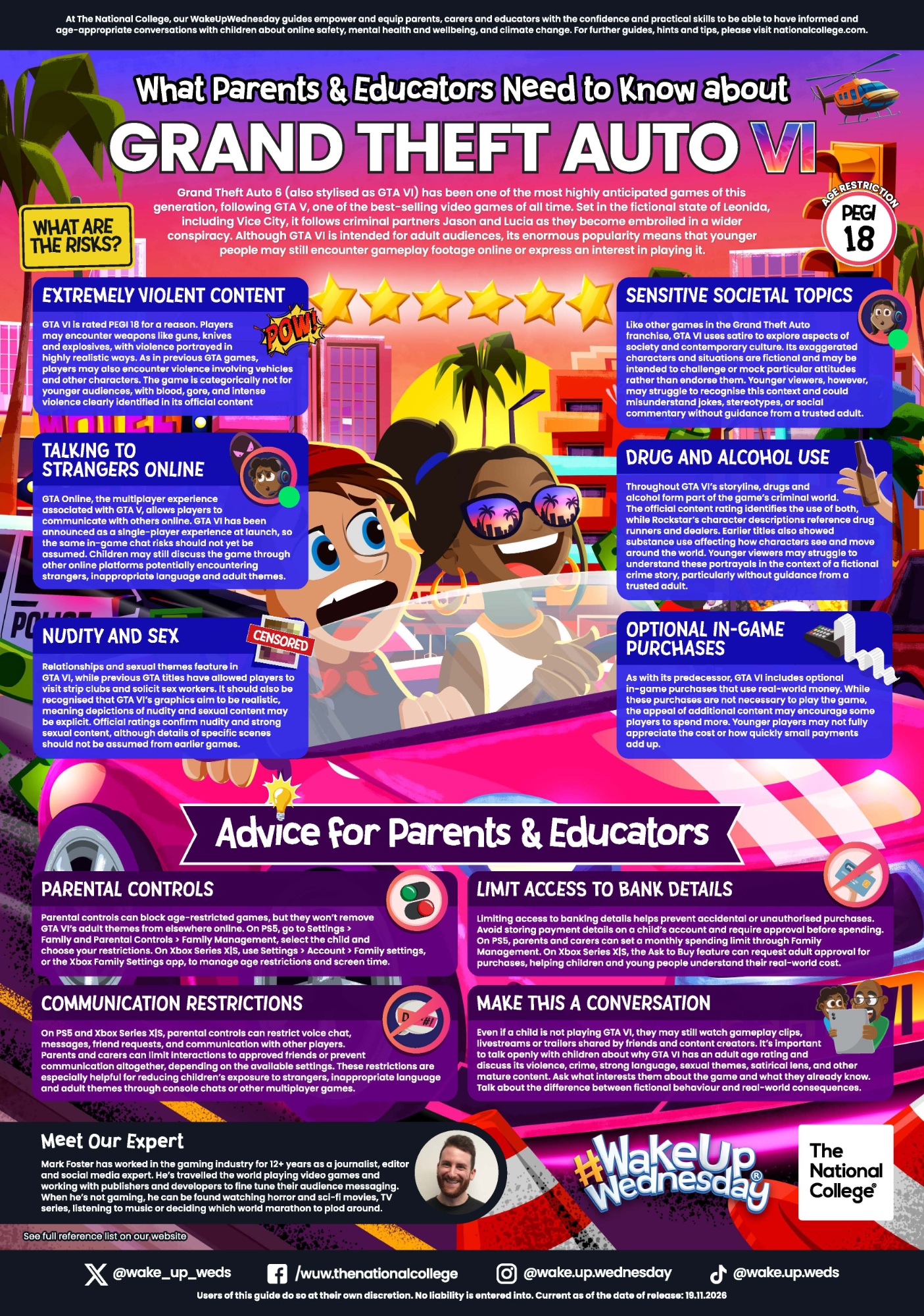
Online Safety Spotlight: What Parents Need to Know About Grand Theft Auto VI (GTA VI)
Why is GTA VI being highlighted? Grand Theft Auto VI is a highly anticipated crime adventure game set in the fictional state of Leonida that follows two criminals navigating a dangerous underworld. Although the game carries a PEGI 18 rating and is strictly intended for adult audiences due to graphic violence, sexual content, drug and alcohol use, and mature social commentary, it holds significant interest for secondary school age students.
Key Risks for Students:
- Second-Hand Exposure: Even if children do not own or play the game directly, they frequently encounter its adult themes through short gameplay clips, livestreams, and social media discussions.
- Unmonitored Interactions: Connecting with online gaming communities can expose young people to interactions with strangers across connected platforms.
- In-Game Spending: Microtransactions and digital purchases present potential financial risks for families.
Recommended Actions for Parents & Carers:
- Enable Parental Controls: Review and set up account restrictions on gaming consoles and mobile devices to manage content access.
- Apply Communication Restrictions: Restrict or monitor voice and text messaging features to prevent unmonitored contact with strangers online.
- Maintain Open Conversations: Talk regularly with your child about the content they encounter online, establishing clear boundaries around age-appropriate media.
If you have any concerns or want further support, please contact one of our Online Safety Leaders Mr Bradshaw dbradshaw@aylshamhigh.norfolk.sch.uk or Mr Allen tallen@aylshamhigh.norfolk.sch.uk
Useful Resources
The following links provide guidance for parents and carers on how to talk to your children about a range of online safety issues. They also show how to set-up child-friendly home filtering and parental controls.
- Childnet has developed guidance for parents and carers to begin a conversation about online safety, as well as guidance on keeping under-fives safe online.
- Thinkuknowby the National Crime Agency - Child Exploitation and Online Protection command (NCA-CEOP) provides resources for parents and carers and children of all ages.
- Parent Info is a collaboration between Parent Zone and NCA-CEOP, providing support and advice for parents and carers related to the digital world from leading experts and organisations.
- National Society for the Prevention of Cruelty to Children (NSPCC) has guidance for parents and carers on online safety.
- UK Safer Internet Centre provides tips and advice for parents and carers - you can also report any harmful content found online through the UK Safer Internet Centre.